A 401(k) employer match is essentially free retirement income most working adults overlook or miscalculate. Every company sets unique matching rules, tiered contribution structures, and annual contribution caps that confuse new and seasoned employees alike.
Many workers pick arbitrary contribution percentages from their paycheck without running accurate math. This casual approach routinely leaves thousands in unclaimed employer matching dollars sitting on the table year after year.
Manual spreadsheets and rough mental math cannot account for tiered matching brackets, annual IRS contribution limits, salary raises, or long-term compound growth projections. Even basic online finance tools skip critical match-focused calculations that directly impact how much free company money you earn.
The best 401 (k) calculator to maximize employer match is built exclusively to solve this planning gap. It inputs your exact compensation, company matching policy, and personal budget constraints to output the precise payroll contribution rate that unlocks 100% of available employer matching funds.
This all-inclusive guide breaks down the risks of manual 401(k) planning, core advantages of specialized matching calculators, non-negotiable tool features, common real-world use cases, a detailed step-by-step workflow, frequent user mistakes to avoid, and expert planning tactics to boost your retirement portfolio long term.
Core Drawbacks of Planning 401(k) Contributions Without a Specialized Match Calculator
Most employees rely on generic budgeting tools, basic spreadsheets, or guesswork to set their 401(k) contribution rates. Each of these methods carries measurable financial downsides that shrink your retirement nest egg over decades.
Guessing Contribution Percentages Wastes Employer Matching Benefits
Every business uses distinct matching formulas. Some firms match 100% of your contributions up to a fixed salary percentage, while others use tiered partial matching across multiple income brackets.
Without structured calculation, employees often contribute too little to hit the full match threshold. Others over-contribute far above the matching cutoff, diverting unnecessary take-home pay into retirement accounts with zero additional company matching reward.
Generic Finance Tools Ignore Tiered Matching Structures
Standard retirement calculators focus solely on compound interest and portfolio growth. They rarely integrate layered employer match rules, vesting schedules, or annual contribution maximums set by federal guidelines.
These generic platforms produce incomplete estimates that fail to show the exact dollar gap between partial matching and full matching eligibility. Users walk away without clear data on how much free cash they are forfeiting each pay cycle.
Manual Spreadsheet Calculations Are Error-Prone and Time-Consuming
Building a custom sheet to track matching requires inputting pay frequency, pre-tax deduction rules, tiered match brackets, and annual caps separately. One misplaced formula or miscalculated percentage skews every projection.
Updating spreadsheets after raises, policy changes, or schedule shifts demands constant maintenance. This repetitive number-crunching creates a barrier for workers who want fast, actionable contribution guidance without advanced math work.
Mental Math Fails to Account for Long-Term Compound Matching Growth
Unclaimed employer match dollars compound alongside your personal contributions year over year. Missing even small monthly matching amounts snowballs into massive lost retirement value after 20 or 30 years of employment.
Humans cannot accurately estimate compound growth tied to variable matching tiers without automated calculation. Rough guesses drastically understate the lifetime financial impact of suboptimal contribution choices.
Lack of Clear Take-Home Pay Tradeoff Visualization
Raising your 401(k) deduction percentage lowers your immediate post-tax paycheck. Many employees avoid maximizing their match out of unfounded fear of crippling monthly cash flow.
Tools not built for matching optimization rarely display side-by-side comparisons of take-home income versus total combined employee + employer retirement deposits. This missing context leads people to prioritize short-term cash over guaranteed free retirement funds.
Key Advantages of Using the Best 401 (k) Calculator to Maximize Employer Match
Integrating a dedicated matching calculator into your annual retirement planning workflow eliminates all the pitfalls of manual planning and generic finance tools. The best 401 (k) calculator to maximize employer match delivers targeted, match-first analysis built for everyday full-time and part-time employees.
Automatically Computes the Exact Contribution Rate for Full Employer Matching
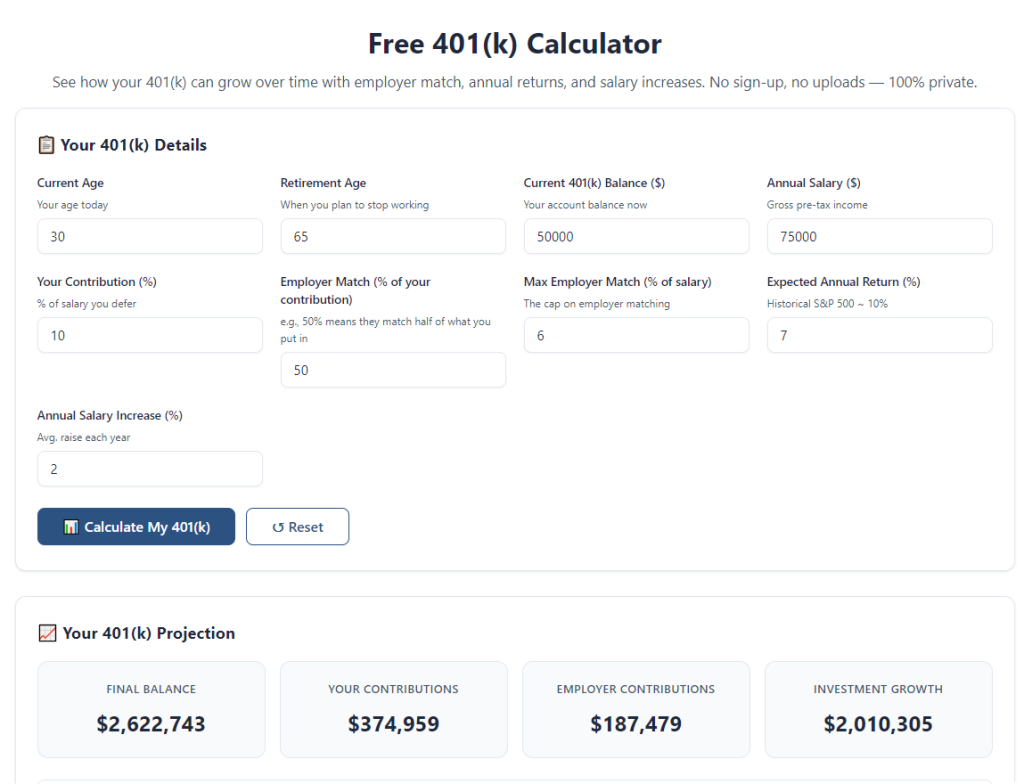
The top-tier matching calculator only requires three core inputs: your annual gross salary, your company’s full matching policy breakdown, and your biweekly or monthly pay cycle.
Within seconds, the tool outputs the minimum payroll percentage you need to deduct to unlock every dollar of available employer matching. It clearly separates the threshold where matching stops, so you avoid over-diverting take-home income past that cutoff point.
Visualizes Side-by-Side Take-Home Pay vs. Total Combined Retirement Deposits
A standout feature of specialized match calculators is the dual comparison panel. It shows your net paycheck amount at every possible contribution tier alongside the total monthly retirement deposit (personal contributions + full employer match).
This transparent data resolves cash-flow anxiety. Employees can see exactly how small reductions in take-home pay unlock hundreds or thousands in annual free company funds.
Integrates Federal Annual 401(k) Contribution Limits Automatically
Premium matching calculators hardcode the official annual pre-tax contribution ceiling. The tool flags any contribution percentage that would push your yearly personal deposits above the legal maximum, preventing accidental over-contributions that trigger administrative corrections.
It also distinguishes between employee-only contribution caps and combined employee + employer total annual limits for full long-term portfolio forecasting.
Models Tiered Matching, Vesting Rules, and Salary Raise Scenarios
Many employers implement multi-tier matching: for example, 100% match on the first 3% of salary and 50% match on the next 2% of salary. The best 401 (k) calculator to maximize employer match processes layered brackets without extra manual data entry.
Advanced versions also include vesting timeline inputs, so users can calculate how much matched money they retain if they leave their role before full vesting. You can also simulate annual salary increases to recalculate optimal contribution percentages long-term.
Produces Long-Term Compound Growth Projections Including All Matching Funds
Unlike basic budget tools, match-focused calculators run compound growth forecasts that include every dollar of employer matching. The report quantifies the total lifetime difference between partial matching contributions and full matching contributions across 10, 20, and 30-year timelines.
This long-range visualization turns abstract percentage rules into tangible six-figure retirement value gaps that motivate smarter contribution choices.
Requires No Advanced Financial Knowledge to Operate
The interface for quality matching calculators uses plain employee-focused language instead of dense finance jargon. Input fields are labeled with straightforward prompts tied directly to your pay stub and benefits handbook.
No background in tax planning, corporate benefits, or compound investing is needed to generate actionable contribution recommendations in under one minute.
Enables Side-by-Side Scenario Testing for Life Changes
Users can duplicate calculation profiles to test multiple life scenarios: a pay raise, a reduced work schedule, switching to a new employer with different matching rules, or adjusting contributions to cover short-term expenses temporarily.
Each separate scenario generates a standalone matching summary, letting you compare how different life shifts impact your ability to capture full employer matching benefits.
Must-Have Features of the Best 401 (k) Calculator to Maximize Employer Match
Not all retirement calculators prioritize employer matching optimization. To identify a true match-focused tool, verify it includes all these employee-centric, match-first core functions.
Tiered Employer Matching Formula Support
The tool must accept multi-level matching rules instead of only flat single-tier matching. It should have separate input fields for each bracket’s matching percentage and salary cap to replicate your exact company benefits structure.
Real-Time Take-Home Pay Estimation
Built-in federal income tax and payroll deduction logic calculates your net paycheck after adjusting your 401(k) contribution rate. This removes guesswork about how deductions impact monthly household cash flow.
Annual IRS Contribution Limit Alerts
Automatic ceiling tracking prevents users from setting contribution percentages that exceed the yearly pre-tax employee limit. Clear pop-up notifications explain the limit and adjust recommended percentages accordingly.
Vesting Schedule Input and Retention Forecasting
Dedicated fields for cliff vesting or graded vesting timelines let the calculator show how much matched employer money you would forfeit if you separate from your employer early. This supports career mobility planning alongside retirement savings goals.
Multi-Year Compound Growth Forecasting With Matching Included
Growth projections must separate personal employee contributions and employer matching funds, then combine both streams to show total portfolio value at 5, 10, 20, and 30-year milestones.
Multiple Pay Cycle Compatibility
Input options for monthly, biweekly, semimonthly, and weekly payroll schedules align calculations with your actual pay frequency, eliminating monthly vs. annual conversion math errors.
Scenario Duplication and Saved Calculation Profiles
The ability to store multiple calculation sets lets you compare current employment matching rules against future job offers or projected salary increases without retyping all base data repeatedly.
Plain-Language Summary Reports
After running calculations, the tool generates a concise printable summary outlining the optimal contribution percentage, total annual employer match dollar amount, take-home pay impact, and long-term portfolio growth difference between partial and full matching.
No Complex Registration or Paid Tier Lock-In (Optional Bonus)
Top accessible matching calculators offer full core matching functionality without mandatory account creation or premium paywalls for critical contribution maximization features.
Common Real-World Use Cases for a 401(k) Employer Match Maximization Calculator
The best 401 (k) calculator to maximize employer match serves every employee type and financial planning milestone, from entry-level new hires to mid-career professionals planning job transitions.
New Hire Onboarding Benefits Planning
When enrolling in your company’s 401(k) plan for the first time, the calculator eliminates confusion around unfamiliar matching policies. New employees plug in their starting salary and company match rules to set their initial contribution rate perfectly on enrollment day.
Annual Open Enrollment Benefits Review
Every yearly open enrollment window is the ideal time to recalculate optimal contributions. Employees input updated annual salaries, revised company matching policies, and adjusted household budget needs to tweak their deduction percentage for the new plan year.
Post-Raise Contribution Recalculation
A salary increase shifts the dollar threshold for full employer matching. Running a fresh calculation after a pay bump adjusts your contribution percentage to maintain full matching eligibility without over-diverting take-home income.
Career Transition and New Employer Comparison
When evaluating a job offer with a different 401(k) matching structure, duplicate calculation profiles let you contrast total annual matching dollars between your current role and prospective new position. This data becomes a critical negotiation and compensation comparison metric.
Temporary Income Adjustment Planning
If you plan to reduce hours, take an unpaid leave, or cut retirement contributions temporarily to cover short-term costs, the calculator shows exactly how much matching income you will sacrifice and how to resume full matching once your budget stabilizes.
Long-Term Early Retirement Projection
Users building an early retirement roadmap run multi-decade growth scenarios with full matching captured each year. The tool quantifies how consistently hitting the full match threshold shortens the timeline to hitting your target retirement portfolio size.
Household Dual-Income Retirement Coordination
Two working spouses can run separate matching calculations and combine their projected total employer match funds to create a unified household retirement savings strategy that maximizes both companies’ benefit programs simultaneously.
Step-by-Step Complete Workflow: How to Use the Best 401 (k) Calculator to Maximize Employer Match
Follow this structured, beginner-friendly process to generate accurate, actionable contribution recommendations that capture 100% of your available employer matching funds.
Step 1: Gather All Required Input Documents and Policy Details
Locate three key pieces of information before opening the calculator to avoid incomplete or inaccurate projections:
- Your current annual gross base salary, including consistent bonuses if eligible for matching
- Your official company 401(k) benefits handbook outlining full tiered employer matching rules
- Your payroll cycle type (weekly, biweekly, semimonthly, monthly)
Also note your plan’s vesting schedule if you intend to factor job mobility into your long-term forecast.
Step 2: Launch the Specialized 401(k) Match Maximization Calculator
Open the tool in your browser. The primary landing page will display a streamlined input form dedicated exclusively to employer matching optimization, with no irrelevant investment risk or generic budgeting tabs cluttering the main workflow.
Step 3: Input Core Personal Compensation and Payroll Data
Fill out the base compensation fields first:
- Annual gross salary
- Pay cycle frequency dropdown selection
- Any consistent annual bonus eligible for matching
Double-check salary figures to ensure the number reflects your full pre-tax income used by your employer to calculate matching contributions.
Step 4: Enter Full Tiered Employer Matching Policy Rules
Navigate to the matching rule input section. For each tier listed in your benefits guide, add:
- The salary percentage cap for that tier
- The employer’s matching percentage applied to employee contributions within the bracket Add multiple tier rows if your business uses layered partial matching formulas. If your employer offers a flat single-tier match, only complete one matching bracket entry.
Step 5: Input Vesting Timeline Details (Optional for Long-Term Forecasting)
If you want to model how much matched funds you retain upon early job departure, fill in the vesting fields: cliff vesting timeline or graded yearly vesting percentage increments. Skip this section if you only need short-term contribution rate guidance for your current role.
Step 6: Set Assumptions for Growth and Salary Changes (Scenario Customization)
Adjust optional advanced settings to match your personal financial outlook:
- Average annual expected salary raise percentage
- Long-term average annual portfolio return rate for compound growth calculations
- Target retirement age for multi-decade total portfolio projections
Leave default balanced growth assumptions if you do not have specific investment return forecasts prepared.
Step 7: Run the Full Matching Maximization Calculation
Select the calculate or generate report button to process all entered data. The tool will instantly produce two core output panels:
- Optimal employee contribution percentage required to unlock the complete employer match
- Side-by-side breakdown of monthly take-home pay at your recommended rate versus lower/higher contribution tiers
Step 8: Review the Annual Employer Match Dollar Summary
Locate the dedicated match summary section to view three critical metrics:
- Total yearly employer matching funds captured at the recommended contribution rate
- Lost annual matching dollars if you select a lower deduction percentage
- Unnecessary excess personal contributions made if you set a rate above the full match threshold
This summary quantifies the tangible financial reward of aligning your payroll deduction with the calculated optimal percentage.
Step 9: Analyze Long-Term Compound Growth Projections
Scroll to the multi-year growth chart and table. Compare two distinct portfolio forecasts:
- Portfolio value if you contribute the optimal percentage and capture full matching every year
- Portfolio value if you under-contribute and miss partial or full employer matching annually
Note the total lifetime dollar gap between the two scenarios to contextualize the long-term impact of your contribution choice.
Step 10: Test Alternate Scenarios With Duplicate Calculation Profiles
Use the duplicate or new scenario function to simulate real-life changes:
- Input a projected salary raise to recalculate updated optimal contribution rates
- Enter a new employer’s matching policy to compare total annual matching benefits
- Lower your contribution percentage temporarily to model short-term budget adjustments and corresponding lost matching funds
Save each separate scenario for easy side-by-side comparison.
Step 11: Export or Print the Final Matching Optimization Report
Generate the condensed printable summary report containing your optimal contribution rate, annual match total, take-home pay impact, and long-term growth estimates. Store this document with your benefits paperwork for reference during open enrollment or salary reviews.
Step 12: Update Your 401(k) Payroll Contribution Percentage Through Your Benefits Portal
Using the calculated recommended percentage, log into your company’s retirement benefits platform and adjust your pre-tax deduction rate to match the tool’s output. Revisit the calculator and rerun this workflow every open enrollment period or after any major compensation change.
Common Costly Mistakes to Avoid When Using a 401(k) Employer Match Calculator
Even with access to the best 401 (k) calculator to maximize employer match, these frequent user errors produce flawed projections and lead to missed matching income year after year.
Entering Net Take-Home Salary Instead of Gross Annual Compensation
Matching calculations rely entirely on your pre-tax gross income. Inputting your post-payroll net paycheck drastically understates your match eligibility threshold and outputs an incorrectly low recommended contribution percentage. Always reference your W-2 or offer letter gross salary number.
Omitting Secondary Matching Tiers for Layered Employer Policies
Users often only input the first matching bracket and ignore secondary partial-match tiers. This incomplete data set causes the calculator to underestimate the required contribution rate to hit the full combined company match. Transcribe every tier listed in your benefits guide in full.
Ignoring Annual IRS Contribution Ceiling Alerts
Some users set contribution percentages high enough to exceed the yearly employee pre-tax limit. The matching calculator flags this conflict, but many dismiss the warning, leading to mid-year plan corrections and missed partial matching from reduced late-year contributions.
Failing to Update Calculations After Salary Raises
A higher annual gross salary raises the absolute dollar cap for employer matching. Reusing an old calculation profile without updating your salary means your contribution percentage will no longer hit the full match threshold post-raise. Rerun calculations immediately after any pay increase.
Disregarding Vesting Rules When Planning Job Moves
Users planning to switch employers often skip vesting input. The resulting forecast overstates the amount of matched employer funds they will actually retain if they separate before full vesting, creating unrealistic retirement savings expectations.
Only Running One Single Scenario Without Comparison Testing
Relying on a single calculation profile removes critical context. Without testing lower contribution tiers or future salary scenarios, you cannot visualize exactly how much free matching income you sacrifice with suboptimal deduction rates.
Using Generic Retirement Calculators Instead of Match-Focused Tools
Generic investment calculators lack tiered matching logic built into specialized tools. Their incomplete analysis will fail to identify the exact minimum percentage needed to capture every dollar of employer matching, leaving free retirement money unclaimed annually.
Expert Pro Tips to Maximize Value From Your 401(k) Employer Match Calculator
Implement these planning tactics to get the most precise, actionable long-term retirement strategy out of the best 401 (k) calculator to maximize employer match.
- Refresh your calculation profile once per open enrollment season, even if your salary and matching policy remain unchanged, to account for updated federal contribution limits.
- Build a dedicated folder to store printed or exported calculation reports from each year, creating a historical record of your matching optimization progress.
- When negotiating a new job offer, run separate calculator profiles for your current role and the prospective position to use total annual matching dollars as a formal compensation comparison metric.
- If your household has two participating employees, run individual matching calculations then combine the total annual employer match figures to build a unified family retirement savings target.
- Test temporary reduced-contribution scenarios ahead of planned major expenses to quantify exactly how much matching income you will forego and create a timeline to resume full matching afterward.
- Pair matching calculator outputs with basic budget tracking to balance maximizing employer benefits with sustainable monthly household cash flow.
- Use multi-decade growth projections to set clear retirement milestones; the compounded matched funds visualized in the report create strong motivation to maintain optimal contribution rates long-term.
Final Thoughts
Employer 401(k) matching represents one of the most guaranteed, risk-free forms of retirement wealth available to working adults. Yet millions of employees fail to capture the full benefit due to incomplete manual math and generic finance tools that overlook layered matching rules.
Guessing contribution percentages or relying on rough spreadsheets creates permanent gaps in your retirement portfolio that compound over decades. The specialized best 401 (k) calculator to maximize employer match eliminates all guesswork by centering every calculation around one core priority: unlocking 100% of your company’s free matching retirement funds.
This tool balances three critical planning pillars: your take-home cash flow constraints, your employer’s unique tiered matching policy, and long-term compound growth including every dollar of matched employer contributions. It works for entry-level new hires, mid-career professionals, dual-income households, and employees evaluating career transitions to new benefit programs.
By following the complete step-by-step calculation workflow, avoiding common costly input mistakes, and retesting scenarios during salary or policy changes, you lock in every available matching dollar year over year. Over a full working career, consistently hitting your full employer match threshold adds substantial six-figure value to your final retirement portfolio with minimal impact on your monthly take-home income.
After learning the operation method, click the link below to enter the tool page for immediate use.