Academic writing follows strict structural and tonal rules that regular content writing does not. Essays, research papers, thesis documents, and scholarly reports demand clarity, formality, and logical flow.
Many students and researchers struggle with consistent readability in their work. They often rely on complex jargon, lengthy sentences, and dense paragraphs that confuse readers and weaken academic quality.
Self-proofreading is notoriously unreliable for academic text. Writers grow familiar with their own arguments and easily overlook awkward phrasing or overly complicated syntax.
The best readability checker for academic writing solves these critical issues. It delivers academic-focused analysis tailored for scholarly papers, far more precise than basic blog or general writing tools.
This in-depth tutorial breaks down the flaws of manual academic proofreading, core tool benefits, must-have academic features, common use cases, and a full step-by-step workflow for flawless scholarly editing.
Why Manual Readability Checks Fail for Academic Writing
Most academic writers rely on self-review or basic grammar tools to polish papers. These outdated methods create consistent weaknesses in scholarly content quality.
Biased self-judgment for complex text
Researchers and students understand their own research deeply. This makes it hard to spot sentences that feel confusing or disjointed to professors, reviewers, or academic readers.
No academic-grade scoring standards
General readability tools target casual web content. They do not align with the formal sentence structure and vocabulary standards required for essays and research papers.
Unnoticed overly wordy syntax
Academic writing often includes redundant phrasing, extended clauses, and repetitive explanations. These subtle flaws weaken paper credibility but evade manual checks.
Inconsistent paragraph flow
Long research papers often develop uneven pacing. Some sections are overly dense, while others lack structure, creating an inconsistent reading experience for evaluators.
Missed formality balance issues
Many writers mix casual phrasing with formal academic language. Manual review cannot consistently flag informal tone that undermines scholarly professionalism.
Extremely time-consuming manual editing
Line-by-line readability revision for long thesis papers takes hours. This delays submissions and leaves less time for actual research refinement.
Key Benefits of the Best Readability Checker for Academic Writing
Integrating the best readability checker for academic writing into your editing workflow drastically improves paper quality while saving valuable research and writing time.
Academic-specific readability scoring
Top tools use scholarly grading metrics designed for essays, dissertations, and research reports. Scores reflect formal writing standards instead of casual web content rules.
Identifies wordy and redundant academic phrasing
The checker flags lengthy clauses, redundant explanations, and bloated sentences common in first-draft academic work. It pinpoints exact sections needing revision.
Preserves necessary academic jargon
Unlike basic tools that simplify all complex words, academic-focused checkers retain valid niche terminology. They only flag unnecessary complicated vocabulary.
Improves logical paragraph and section flow
The tool analyzes paragraph length and transition consistency. It helps writers structure arguments in a clear, progressive order ideal for scholarly evaluation.
Maintains formal academic tone
It detects informal phrases, conversational words, and casual syntax. This ensures your paper meets the strict tonal requirements of academic institutions.
Speeds up thesis and paper editing cycles
Automated readability analysis condenses hours of manual proofreading into minutes. Writers can focus on research depth instead of repetitive structural edits.
Creates consistent writing standards for long papers
Thesis and dissertation writers maintain uniform readability across hundreds of pages. This consistency greatly improves overall paper professionalism.
Must-Have Features of the Best Readability Checker for Academic Writing
Not all readability tools support scholarly writing. The true best readability checker for academic writing includes these specialized academic-focused features.
Scholarly readability index scoring
Reliable tools display multiple formal readability indexes tailored for education and research. These scores match university grading and publication standards.
Academic sentence structure analysis
The tool detects run-on research sentences, excessive clause stacking, and awkward syntax. It offers targeted fixes for formal academic structure.
Jargon validation and redundancy checks
It differentiates necessary field-specific jargon from unnecessary complex words. This unique feature protects academic accuracy while boosting clarity.
Formal tone detection
Advanced tools scan for informal language, contractions, and conversational phrasing that violate academic writing guidelines.
Long-document compatibility
Academic work often includes thousands of words. Premium academic checkers support full thesis, research paper, and dissertation text pasting with no length limits.
Argument flow evaluation
The tool analyzes paragraph transitions and logical progression. It highlights disjointed sections that weaken academic argument structure.
Edit suggestions for scholarly context
All revision tips follow academic writing conventions. Suggestions improve clarity without dumbing down complex research ideas or professional analysis.
Common Academic Use Cases for Readability Checkers
The best readability checker for academic writing serves every type of student, researcher, and scholarly writing project across all disciplines.
High school and college essay writing
Students refine class essays, argumentative papers, and reflective writing. The tool ensures clear, formal text that meets teacher and professor standards.
Undergraduate and graduate research papers
Formal research submissions require precise readability. The tool polishes analysis sections, methodology paragraphs, and conclusion content perfectly.
Thesis and dissertation editing
Long graduate-level documents benefit massively from consistent readability checks. Uniform structure and clarity improve thesis defense and grading outcomes.
Academic journal article drafting
Researchers preparing journal submissions use the tool to meet publication readability standards. Clear writing increases acceptance chances for scholarly print.
Scholarly report and case study writing
Professional academic reports and case studies demand structured, formal text. The tool eliminates messy syntax and unclear explanations.
Application and academic statement refinement
Personal statements and research proposals require balanced formality and clarity. The tool polishes tone without removing unique personal perspective.
Revision of old academic work
Updating past research papers or expanding old essays becomes easier. The tool standardizes readability across revised and new content sections.
Step-by-Step Guide: Use the Best Readability Checker for Academic Writing
Follow this academic-focused workflow to analyze, edit, and perfect your scholarly writing with professional readability results.
Step 1: Complete your full academic draft
Finish your entire paper, essay, or thesis section first. Focus on research content, arguments, and data during your initial writing phase.
Avoid over-editing for clarity while drafting. Prioritize capturing all research ideas before starting the readability refinement process.
Step 2: Copy your full scholarly text
Select and copy your complete written content. Include all body paragraphs, analysis sections, and explanatory text for full accurate analysis.
You may exclude reference lists, citations, and headings since these elements do not impact core readability scores.
Step 3: Launch the academic readability checker
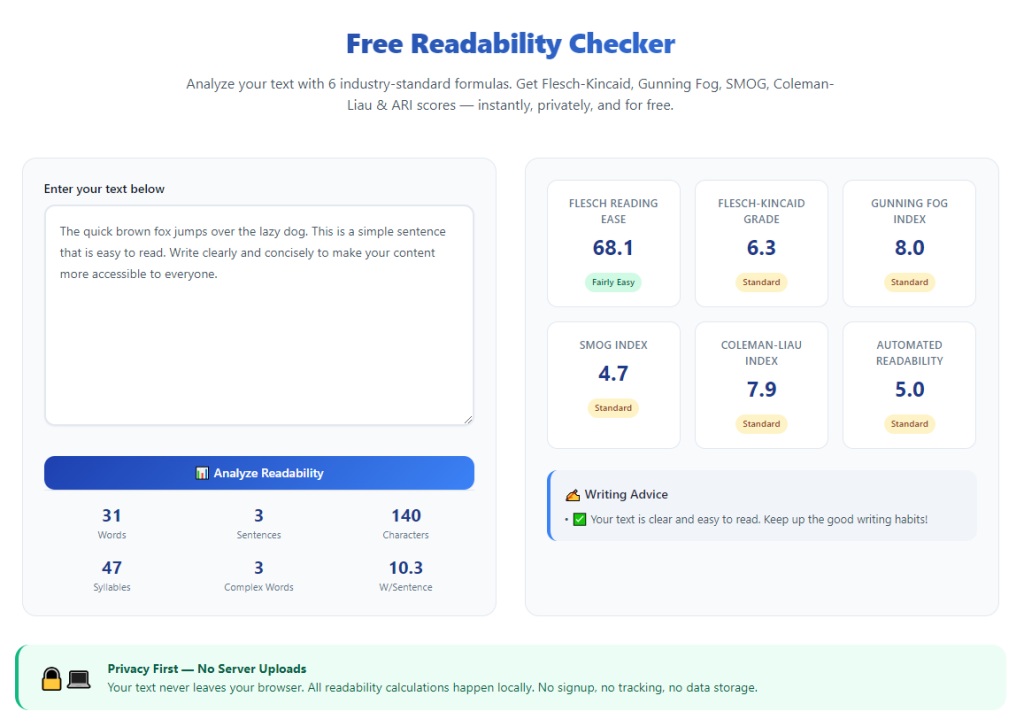
Open the tool in your browser. The academic version features a clean interface built specifically for long-form formal writing analysis.
Familiarize yourself with core modules: readability scoring, sentence analysis, tone checking, and academic revision suggestions.
Step 4: Paste your academic content
Paste your full paper text into the tool’s input field. Confirm all paragraphs and sections appear correctly with no missing content.
Preserve original paragraph breaks, as structural spacing directly impacts academic readability evaluation results.
Step 5: Run formal academic analysis
Click the analyze button to start the scholarly readability scan. The tool will process long-form content in seconds with high precision.
Once complete, the dashboard displays your overall academic readability grade and a detailed breakdown of structural and tonal issues.
Step 6: Review academic readability scores
Compare your results to standard academic writing benchmarks. Different education levels require different readability ranges for optimal grading.
Note weak-scoring sections, including overly complex paragraphs, lengthy sentences, and informal phrasing patterns.
Step 7: Revise complex sentence structures
Address all highlighted run-on sentences and over-clustered clauses. Split extended explanations into concise, structured formal sentences.
Keep necessary technical terms intact while simplifying redundant wordiness that clouds your research arguments.
Step 8: Fix tonal and structural inconsistencies
Replace casual phrasing, contractions, and conversational language with formal academic alternatives.
Restructure uneven paragraphs to ensure every section delivers focused, logical progression for your research topic.
Step 9: Re-scan your revised academic content
After completing edits, copy your updated text and run a second analysis. Compare new scores against the original baseline results.
Continue minor revisions until your paper meets ideal academic readability standards for your course or publication.
Step 10: Finalize and format your paper
Once your readability score is optimized, transfer the polished text back to your document editor.
Add final citations, formatting, references, and layout adjustments before submitting your academic work.
Common Mistakes to Avoid With Academic Readability Checking
Even with the best readability checker for academic writing, these frequent errors can lower the quality of your scholarly papers.
Over-simplifying valid academic jargon
New writers often replace necessary technical terms to boost scores. This reduces research accuracy and weakens academic credibility.
Blindly accepting all automated edits
Generic suggestions may alter your unique research voice or argument structure. Always review changes to preserve academic originality.
Ignoring paragraph flow for score gains
Focusing only on sentence length can break logical argument flow. Prioritize coherent reasoning over perfect numerical scores.
Checking readability only at final submission
Waiting until completion creates massive revision workloads. Regular checks during drafting maintain consistent quality.
Using casual readability standards for research work
Blog-level simplicity does not fit academic writing. Scholarly work requires moderate formality, not overly basic sentence structure.
Neglecting tone consistency across long papers
Thesis writers often shift tone across chapters. Failing to standardize formality creates disjointed professional quality.
Expert Tips to Maximize Academic Writing Quality
Final Thoughts
Readability is a foundational component of successful academic writing. Clear, formal, and structured text helps readers understand complex research, evaluate arguments fairly, and recognize scholarly effort.
Manual self-editing cannot match the precision of academic-focused analysis. Human bias and familiarity hide structural flaws that impact grading and publication success.
The best readability checker for academic writing eliminates these limitations. It delivers specialized, scholar-grade analysis that balances clarity, formality, and research accuracy.
It serves students, graduate researchers, and professional academics working on essays, theses, journal articles, and formal reports.
By following this step-by-step guide and expert tips, you can consistently produce polished, readable, and professional academic writing that stands out in classrooms and scholarly publications.
After learning the operation method, click the link below to enter the tool page for immediate use.