Retirement planning is one of the most critical long-term financial tasks every working adult must prioritize. Yet countless people delay serious retirement preparation due to uncertainty about future growth, unclear savings targets, and a lack of accurate projection tools. Many individuals rely on rough estimates, generic math formulas, or basic calculators that fail to account for long-term compound growth, regular monthly contributions, and variable interest rates. These inaccurate approximations lead to under-saving, unrealistic retirement expectations, and last-minute financial stress as people near their retirement age.
Unlike short-term savings calculations, retirement forecasting spans decades, meaning even tiny calculation errors compound exponentially over time and create massive gaps in your final retirement fund. This is why choosing the best compound interest calculator for retirement planning is non-negotiable for anyone building a sustainable retirement nest egg. A specialized retirement-focused compound calculator is engineered for long-term financial modeling, packing advanced features tailored exclusively for 10, 20, 30, or even 40-year wealth growth projections. In this comprehensive 1800+ word guide, we will break down why generic calculators fail retirement planning, key features of the best compound interest calculator for retirement planning, step-by-step usage instructions, common planning mistakes, and pro tips to maximize your retirement savings strategy.
Why Generic Calculators Fail Long-Term Retirement Planning
Standard compound interest calculators work fine for short-term savings goals like vacation funds or down payments, but they fall drastically short when applied to retirement planning. Retirement finance has unique variables that basic tools cannot accommodate, making them unreliable for long-term wealth forecasting.
First, most generic calculators prioritize simple lump-sum calculations and overlook recurring monthly contributions, which are the backbone of retirement savings. Nearly all working adults build retirement funds through consistent monthly deposits into retirement accounts, not one-time large investments. Basic tools often downplay or lack detailed recurring contribution settings, leading users to vastly underestimate their final retirement balance over multiple decades.
Second, generic tools ignore retirement-specific compounding variables. Long-term retirement investments feature fluctuating average annual returns, tax-advantaged growth, and incremental savings increases over time. Many users raise their monthly contributions as their income grows, a key variable standard calculators do not support. Without these customizable settings, projections feel static and fail to reflect real-world retirement saving behavior.
Third, basic calculators offer no long-term growth visualization. Retirement planning requires understanding gradual year-over-year growth and the compound snowball effect that accelerates in later years. Generic tools only display a single final number, leaving users unable to track progress, adjust savings habits, or understand how small monthly changes impact decades-long growth. Thebest compound interest calculator for retirement planning solves all these flaws by focusing entirely on long-term retirement financial modeling, delivering dynamic, realistic projections aligned with real investment scenarios.
Key Features of the Best Compound Interest Calculator for Retirement Planning
A top-tier best compound interest calculator for retirement planning includes exclusive retirement-focused features that generic financial tools lack. These specialized functions make precise, personalized retirement forecasting possible for beginners and seasoned investors alike.
Decades-long timeline support: Unlike basic calculators limited to short time frames, this tool supports ultra-long projection windows up to 40 years, perfectly matching standard working career and retirement saving timelines. It accurately models slow, steady compound growth over extended periods without mathematical degradation.
Custom recurring contribution modeling: The core feature for retirement planning. Users input monthly or annual retirement contributions, adjust deposit frequencies, and even simulate annual savings increases to mirror salary raises and growing investment capacity over time.
Adjustable average annual return rates: Retirement portfolios blend stocks, bonds, and index funds with variable long-term returns. The best compound interest calculator for retirement planning lets users input conservative, moderate, and aggressive return rates to build multiple risk-based scenarios.
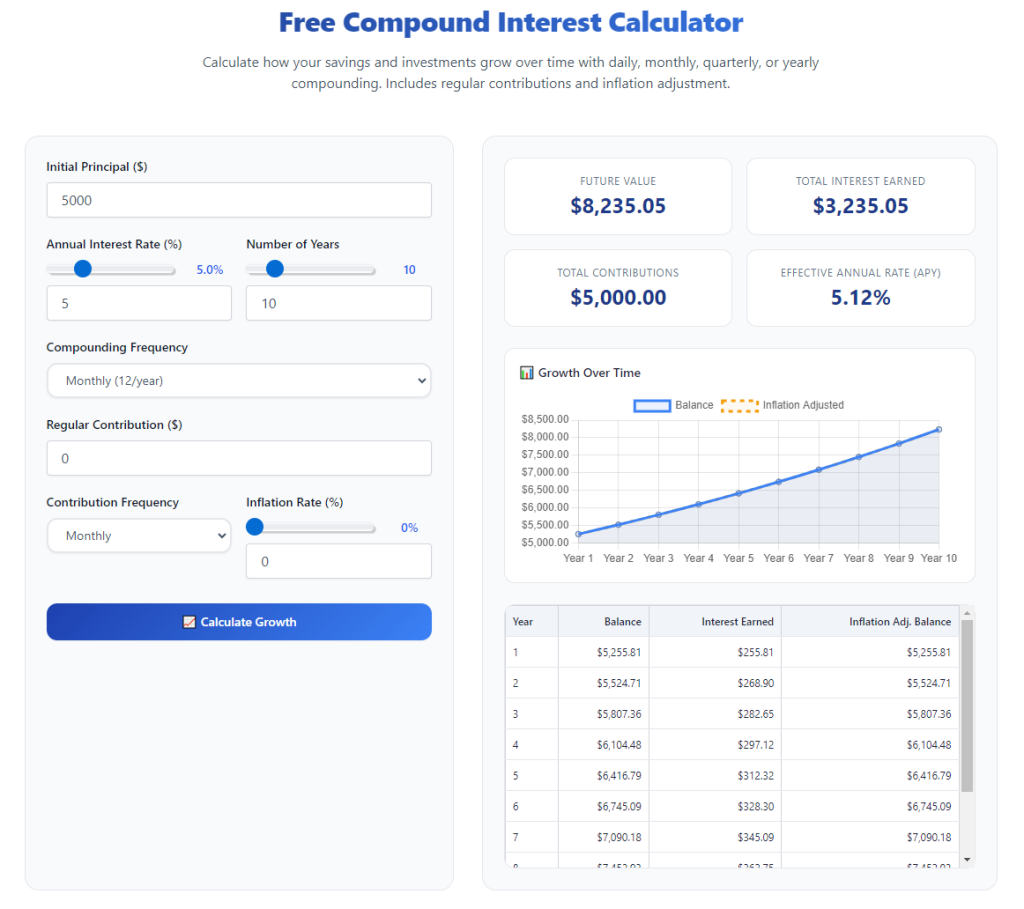
Detailed year-by-year retirement growth breakdown: Instead of a single final figure, the tool generates annual balance reports, showing total contributions, accumulated compound interest, and net growth each year. This helps users visualize the compound snowball effect critical for long-term retirement wealth.
Principal and interest separation metrics: It clearly distinguishes how much of your final retirement fund comes from personal contributions versus compound interest earnings. This eye-opening metric proves why early, consistent saving is far more valuable than late large deposits.
Risk scenario comparison tools: Users can run side-by-side projections for low-risk, medium-risk, and high-risk investment strategies, making it easy to balance risk tolerance with retirement savings goals.
Core Benefits of Using a Retirement-Specific Compound Interest Calculator
Investing in long-term retirement planning with the best compound interest calculator for retirement planning delivers transformative benefits for your financial future, far exceeding what basic tools can offer.
Eliminates retirement savings guesswork: Most people save arbitrary amounts each month without knowing if their pace will support a comfortable retirement. This calculator delivers data-driven targets, so you save exactly what you need instead of over-saving unnecessarily or under-saving dangerously.
Maximizes the power of early compounding: The tool clearly demonstrates how saving small amounts in your 20s and 30s outperforms large deposits in your 40s and 50s. This visual insight motivates consistent early saving, the single biggest predictor of retirement success.
Enables strategic retirement adjustments: Life changes like salary increases, career breaks, or extra bonus deposits can all be modeled instantly. You can test how increasing monthly contributions by a small percentage accelerates your retirement timeline and final fund size.
Simplifies complex retirement math: Decades of compound growth involves advanced mathematical formulas that are nearly impossible to calculate manually. The best compound interest calculator for retirement planning automates all complex computations, delivering accurate results in seconds with zero manual work.
Builds long-term financial discipline: By viewing clear annual growth projections, users stay motivated to maintain consistent saving habits and avoid withdrawing retirement funds prematurely, protecting long-term compound growth potential.
Common Real-World Use Cases for Retirement Compound Calculators
The best compound interest calculator for retirement planning adapts to every stage of your career and retirement journey, supporting diverse financial goals and planning scenarios.
Early-career retirement foundation building: Young professionals just starting their careers can use the tool to see how minimal monthly contributions grow exponentially over 30 to 40 years. This encourages early retirement account enrollment and consistent small-scale saving.
Mid-career retirement gap fixing: Users in their 30s and 40s who delayed saving can run catch-up scenarios to calculate exactly how much extra they need to contribute monthly to hit their target retirement fund.
Investment strategy comparison: Savers can compare returns from low-risk bond portfolios versus moderate index fund investments to choose a retirement strategy that matches their risk tolerance and timeline.
Pre-retirement final planning: Users approaching retirement can model final growth projections to estimate their exact retirement fund value, plan withdrawal strategies, and adjust final-year contributions for maximum growth.
Financial education and goal setting: New investors can learn compound interest fundamentals, understand long-term wealth building, and set realistic, measurable retirement goals based on accurate data.
Step-by-Step Guide to Using the Best Compound Interest Calculator for Retirement Planning
This beginner-friendly workflow works for all premium versions of the best compound interest calculator for retirement planning. Follow these steps to generate hyper-accurate, personalized retirement projections in under one minute.
Step 1: Input Your Current Retirement Principal
Start by entering your existing retirement account balance, including 401(k), IRA, or personal retirement investment funds. This baseline number ensures all future growth calculations build on your actual current financial position, avoiding inaccurate blank-state projections.
Step 2: Enter Monthly or Annual Retirement Contributions
Input the consistent amount you deposit into your retirement funds each month or year. For the most realistic results, use your average regular contribution amount. If you plan to increase savings annually with salary raises, note this variable for later scenario testing.
Step 3: Set a Realistic Average Annual Return Rate
Select an annual return rate aligned with your portfolio type. Conservative retirement portfolios typically see steady lower returns, while diversified stock-heavy portfolios deliver higher long-term average returns. Avoid overly optimistic rates to ensure safe, reliable planning.
Step 4: Choose Your Investment Compounding Frequency
Most retirement accounts compound interest monthly or annually. Match the compounding frequency to your official account terms to eliminate calculation discrepancies and ensure precise long-term growth modeling.
Step 5: Input Years Until Planned Retirement
Enter the exact number of years you plan to continue investing before retirement. Whether you are planning for a standard retirement age or early retirement, this timeline calibrates all growth calculations to your personal goals.
Step 6: Generate and Analyze Full Retirement Projections
Run the calculation to view your final projected retirement balance, total personal contributions, total compound interest earned, and complete year-by-year growth breakdown. Review how your wealth grows slowly in early years and accelerates dramatically in later compounding stages.
Step 7: Test Multiple Optimization Scenarios
Adjust individual variables to optimize your plan. Test raising monthly contributions, switching to a higher-yield portfolio, or adding annual lump-sum deposits to see how each change boosts your final retirement fund value.
Common Retirement Calculation Mistakes to Avoid
Even with the best compound interest calculator for retirement planning, user errors can create misleading projections that derail your financial plan. Avoid these critical mistakes for fully accurate results.
Using overly optimistic return rates: Overestimating annual investment returns leads to unrealistic retirement expectations and insufficient monthly savings. Always use conservative average long-term market returns for safe planning.
Ignoring recurring contribution growth: Failing to account for future salary increases and higher monthly savings will produce understated projections, making your plan unnecessarily strict.
Forgetting existing principal balance: Starting calculations from zero instead of your current retirement fund balance skews all long-term growth data and underestimates your final wealth potential.
Only testing one scenario: Relying on a single projection leaves no room for market volatility or life changes. Always test conservative, moderate, and optimistic scenarios to build a flexible retirement plan.
Pro Tips to Maximize Your Retirement Calculator Results
Use these expert strategies to leverage the full power of the best compound interest calculator for retirement planning and build a bulletproof retirement strategy.
- Update projections quarterly: Refresh your calculations whenever you adjust contributions, switch investment portfolios, or receive raises to keep your retirement plan current and accurate.
- Prioritize long-term consistency over large one-time deposits: Use the calculator to compare results—small, steady monthly contributions always outperform sporadic large deposits over decades of compounding.
- Plan for market volatility: Always reference conservative projections to ensure your retirement fund remains stable even during market downturns.
- Optimize contribution increments: Test small monthly increases of 5% to 10% annually to see massive long-term growth gains with minimal short-term budget impact.
Final Thoughts
Retirement planning is the foundation of long-term financial security, yet millions of people plan their future based on guesswork and generic math. Basic compound calculators lack the depth, customization, and long-term modeling capabilities required for accurate retirement forecasting, leaving savers at risk of underfunding their golden years.
The best compound interest calculator for retirement planning fills this critical gap by delivering retirement-specific, data-driven projections tailored to decades-long wealth growth. It accounts for recurring contributions, variable investment returns, extended timelines, and real-world saving habits to paint a clear, honest picture of your financial future. By visualizing compound growth year by year, you gain the motivation and clarity to maintain consistent saving habits, optimize your investment strategy, and avoid common retirement planning pitfalls.
Whether you are just starting your retirement journey, playing catch-up on savings, or fine-tuning a mature retirement portfolio, this specialized tool is the ultimate resource for confident financial planning. Stop relying on vague estimates and start using the best compound interest calculator for retirement planning to build a secure, sustainable, and prosperous retirement future.
After learning the operation method, click the link below to enter the tool page for immediate use.