Academic writing demands strict adherence to originality rules across all levels of education. From short class essays to lengthy research papers and formal theses, every piece of student work must be unique and properly cited. Even accidental overlap with existing sources can lead to serious consequences, including lower grades, course penalties or academic record issues.
Many students rely on basic free tools that deliver shallow scans, miss paraphrased content or produce inaccurate results. These simple scanners are not built to meet the high standards of educational institutions. When your grades and academic reputation are on the line, choosing the best plagiarism checker for academic papers becomes a critical part of your writing routine.
A dedicated academic plagiarism tool is designed specifically for student work. It digs deep into text, compares content against vast academic databases, and highlights every form of duplicate material. This guide will walk you through why specialized tools matter, key features to look for, common pitfalls, real use cases and a full step-by-step workflow to use the best plagiarism checker for academic papers effectively.
Why Academic Papers Need a Specialized Plagiarism Checker
General plagiarism scanners work fine for casual content, but they fall short when used for school and university assignments. Understanding these differences helps you see why the best plagiarism checker for academic papers stands apart from regular tools.
Matches against academic databases
Standard tools only scan public web pages. Top academic checkers compare your work against journals, published papers, thesis archives and library resources. This catches matches that basic scanners completely miss.
Detects paraphrased and reworded content
Many students rephrase sentences to avoid direct copies. Advanced academic tools identify similar structure and wording, even when original phrases are fully rewritten. This aligns with strict school plagiarism policies.
Supports long-form academic content
Research papers, dissertations and extended essays run to thousands of words. The best plagiarism checker for academic papers handles long documents smoothly, without splitting files or limiting text length.
Recognizes formal citations and references
Proper citations, quotes and reference lists are standard in academic writing. Quality tools exclude correctly formatted sources from duplicate counts, so valid references do not trigger false alerts.
Complies with school originality standards
Most colleges and universities set clear originality thresholds. Academic-focused scanners generate results that match these requirements, so you know exactly if your paper meets submission rules.
Common Weaknesses of Generic Plagiarism Tools for Students
Before selecting the best plagiarism checker for academic papers, it is important to learn the flaws that make ordinary tools unsafe for formal school work.
Limited database coverage
Regular scanners only crawl public websites and blogs. They have no access to academic journals, past student papers or peer-reviewed content. This means major duplicate sections remain hidden.
Frequent false positive flags
Basic tools flag common academic phrases, technical terms and standard definitions as plagiarism. Students waste time revising legitimate content that does not violate any rules.
Cannot detect paraphrasing
Simple tools only spot word-for-word copies. Rewritten ideas and reorganized sentences pass undetected, leaving students exposed to hidden plagiarism risks.
Unreliable on long documents
Many free tools crash or cut off text when scanning long research papers. Partial scans create incomplete results that give students a false sense of security.
No detailed academic-style reports
Generic tools offer only basic highlights. They do not organize results by source, citation issues or similarity percentage, making it hard to prepare for teacher review.
Key Features of the Best Plagiarism Checker for Academic Papers
When shopping around for the best plagiarism checker for academic papers, focus on these core professional features that cater directly to student and university needs.
Comprehensive academic database access
The tool must connect to educational archives, research journals, published essays and existing student papers. Wider database coverage ensures every potential match gets detected.
Advanced paraphrasing detection
Smart algorithms analyze sentence structure, word choice and logical flow. It catches lightly reworded content that would slip past basic web-based scanners.
Intelligent citation recognition
It automatically identifies in-text quotes, footnotes and reference sections. Correctly cited material is separated from true duplicate content to reduce unnecessary edits.
Full similarity percentage scoring
Clear percentage results show the overall similarity rate of your paper. Most schools use this number to judge originality, so measurable scores are essential for submission.
Long document support
It handles full research papers, dissertations and multi-chapter work without word limits. You can upload the complete file for one full and accurate scan.
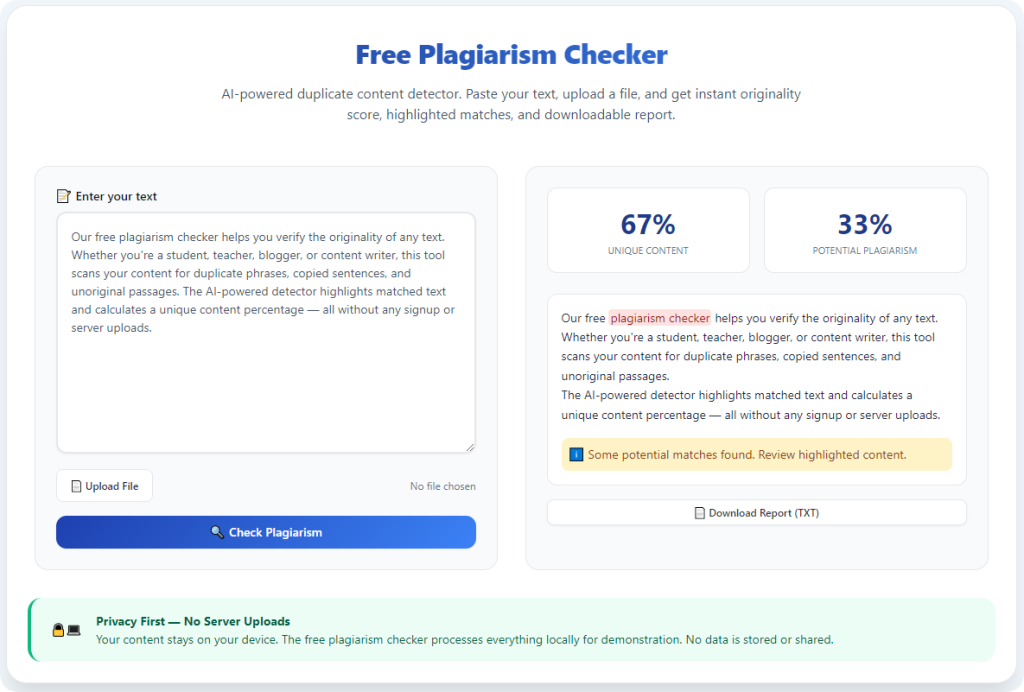
Detailed downloadable academic reports
Professional reports list matched sources, highlight similar text and display final similarity scores. You can save or share reports for teacher verification or personal records.
Strict content privacy protection
Original student papers are valuable personal work. Top tools never store or share uploaded documents, keeping your unpublished writing safe from leaks.
Main Use Cases for Academic Plagiarism Checkers
The best plagiarism checker for academic papers serves students across all education levels and covers nearly every type of written school assignment.
Class essays and short assignments
High school and college students use the tool to check weekly essays and short writing tasks. Quick scans ensure basic originality before daily class submissions.
Research papers and term projects
Long term papers require deep fact-checking and citation work. Scanning the full document helps writers fix accidental overlaps with existing research content.
Theses and dissertations
Graduate students rely on academic scanners for formal theses. Low similarity rates are a mandatory requirement for graduation and degree approval.
Lab reports and academic summaries
Scientific and technical writing often uses standard terminology. Smart citation filters prevent formal lab content from being marked as duplicate work.
Group projects and collaborative writing
When multiple students work on one paper, different writing styles may create accidental similarities. A full scan unifies the work and ensures overall originality.
Post-submission self-review
Many students run scans after getting feedback. This helps them revise weak sections and improve writing habits for future assignments.
Step-by-Step Guide: Use the Best Plagiarism Checker for Academic Papers
Follow this structured workflow to get accurate, school-ready results every time you use the best plagiarism checker for academic papers.
Step 1: Finalize Your Academic Paper
Complete all writing, editing and grammar fixes first. Make sure all quotes, citations and reference lists are formatted according to your school’s style guide.
Split extremely long papers into logical chapters if needed, to keep scanning stable and results easy to review.
Step 2: Launch Your Academic Plagiarism Tool
Open a trusted tool built as the best plagiarism checker for academic papers. Confirm it supports academic databases and citation recognition before starting.
Step 3: Upload or Paste Your Full Document
Upload your saved file or paste the complete text into the input area. Avoid cutting or removing any sections, as partial text leads to wrong similarity scores.
Double-check that references, footnotes and appendices are all included for a full comprehensive scan.
Step 4: Configure Scan Settings
Turn on citation exclusion and academic database matching features. These settings are key to getting results that match your school’s evaluation rules.
Select your preferred report format if you plan to download results later for official use.
Step 5: Start the Full Scanning Process
Begin the scan and wait patiently. Deep academic scanning takes longer than basic web scans, especially for long research papers.
Do not close the tool or refresh the page while the analysis is running.
Step 6: Review Similarity Scores and Highlights
Once scanning finishes, check the overall similarity percentage first. Compare this number against the limit set by your school or professor.
Read through color-coded highlights to separate true duplicate text from properly cited quotes and standard phrases.
Step 7: Revise and Rewrite Problem Sections
Rewrite content marked as direct matches or heavy paraphrasing. Add new analysis and original ideas to lower the similarity rate.
Update citations for referenced material to make all sourced content fully compliant.
Step 8: Re-Scan and Export Final Report
Run a second full scan after revisions to confirm improved scores. When your paper reaches an acceptable originality level, download and save the official report.
Keep the report stored alongside your paper for future reference or teacher review.
Common Scanning Issues & Simple Fixes for Academic Work
Even with the best plagiarism checker for academic papers, minor issues can appear during use. Apply these quick solutions for reliable results.
High similarity from reference lists
Enable citation and reference exclusion in settings. Standard reference formats will no longer raise unnecessary similarity rates.
Too many false positive highlights
Most common in technical papers. Use the tool’s academic phrase filter to ignore universal terms and field-specific vocabulary.
Slow scanning for long research papers
Divide the document into chapters and scan one section at a time. This speeds up processing without losing accuracy.
Inconsistent scores across multiple scans
Always scan the exact final version of your paper. Small edits or missing paragraphs will change similarity percentages.
Expert Tips for Academic Plagiarism Checking
Use these professional tips each time you use the best plagiarism checker for academic papers to maintain high originality and follow academic rules.
- Scan your paper at least two days before the deadline. Leave time for revisions and rechecks.
- Follow your school’s citation style strictly to avoid citation-related similarity flags.
- Focus revisions on exact matches first, as these carry the highest academic risk.
- Do not rely only on automated tools; always proofread manually for logical flow and original ideas.
- Keep all downloaded scan reports organized for your course records.
- Avoid sharing your unfinished papers with others to protect your original work.
Final Thoughts
Originality is the backbone of honest academic work. In today’s education environment, every student must verify their papers before submission to avoid unfair penalties and damaged academic standing.
Generic plagiarism tools cannot meet the strict requirements of essays, research papers and theses. Investing time to use the best plagiarism checker for academic papers gives you full confidence in your work.
With access to deep academic databases, paraphrasing detection and citation support, these specialized tools turn a complex compliance task into a simple routine. You can spot issues early, rewrite effectively and submit papers that fully meet institutional standards.
Whether you are working on a short class assignment or a full graduate thesis, a dedicated academic plagiarism checker is an essential part of your writing toolkit. Build regular scanning into your workflow, and keep your academic work original, credible and fully compliant at every stage.
After learning the operation method, click the link below to enter the tool page for immediate use.